Youtube Videos!
01/09/2010
Just posted two youtube videos to the blog
For the latest information and up to date ideas and conversations check out the
Blog
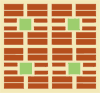
Cites, old and new, display a large collection of patterns, some dating back millennia and some very recent. Can anyone of these be used when laying out a new city district? Are the recent ones unquestionably contemporary and, therefore, most suitable or could old ones be just as suitable for current use?
| 100 AD | 1500 AD | 1750 AD | 1930 AD |
 |
 |
 |
 |
| Timgad | Palma Nova | Savannah | Radburn |
On the evidence that each and every one of these patterns has been applied in many a city or district, and that they have been in continuous use and still intact as part of certain cities’ fabric, we may reason that each is equally suitable for replication. In this vein, any historic urban pattern can also be a contemporary pattern.
Yet we know intuitively and by inspection that this statement could not be true. First the emergence of different patterns speaks to “intent”, a purpose, a determination to satisfy a set of requirements so as to make living in a place comforting and gratifying. Second, the change from one pattern to the next, we generally perceive as evolution, an adaptation and not an accident. An adaptation is thought to be necessary when the needs to which the original pattern responded have changed. Differentiation and adaptation both raise the question of “contemporariness”. Each of these historic patterns could have been “contemporary” at the time of their conception but not necessarily at other times.
We may never know the exact intent for the introduction of patterns that recede into the distant past. We may also not be able to decipher the exact causal chain between living patterns and urban patterns the way we do for many biological adaptations and their purpose.
But we do know with unshakeable certainty that the 20th century brought momentous and rapid changes in the activities of production, provision, protection, transportation, communication and governance – the patterns of survival - the sum total of which constitutes the evolving human, and now mostly urban, culture.
| 100 CE | 1500 CE | 1750 CE | 1950 CE |
 |
 |
 |
 |
| Transportation in urban settlements in the last two millennia | |||
In experiencing the impact of these changes first hand on the daily activity cycle, an inescapable question arises: WHAT IS A CONTEMPORARY URBAN PATTERN?
One answer is presented in this site: the Fused Grid. It is an adaptation and an evolution of previous patterns and a recombination of their essential, positive characteristics.
Rather than defining it in words, this site presents the Fused Grid, by way of example, in the language of planners, developers and transportation specialists: diagrams, models and images. Its contemporary nature emerges through the rationale for each design element that has been incorporated in the pattern.
To support the pattern’s fitness for contemporary living, this site presents direct and inferential evidence that underpins its approach. Examples of applications and schematic designs are also given as aids to implementation.
